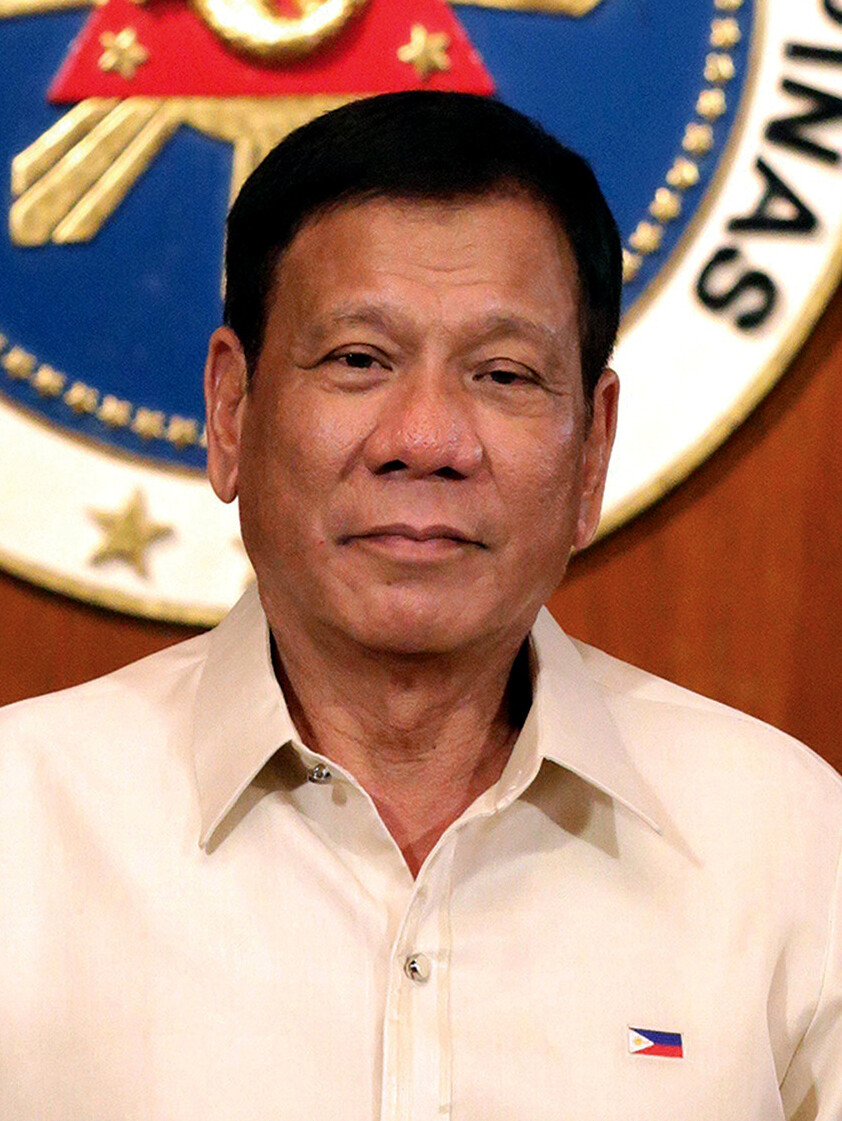
Rodrigo Roa Duterte
Mayor
Davao City
About
Rodrigo Roa Duterte (born March 28, 1945), also known by the nickname "Digong," is a Filipino lawyer and politician who served as the 16th President of the Philippines from 2016 to 2022. He is the first president from Mindanao and the first local chief executive to be elected directly to the office of the presidency.
Career Timeline
(OIC) Vice Mayor
Rodrigo Duterte was appointed as the Officer-in-Charge (OIC) Vice Mayor of Davao City.
Rise of the Alsa Masa and Anti-Communist Vigilantism
The "Alsa Masa" vigilante group emerged in the Agdao district of Davao City to fight communist influence, marking a period of intense and often uncontrolled violence.
Elected as Mayor
Elected Mayor of Davao City for the first time
Transformation of Davao City Security
Rodrigo Duterte began his first term as Mayor of Davao City and initiated a hardline security strategy to restore order.
Transformation of Davao from "No Man's Land"
Following his election as Mayor, Rodrigo Duterte began a long term effort to rehabilitate Davao City's reputation as a violent "no man's land" plagued by insurgency and crime.
Founding of the Lingap Center for the Mentally Challenged
Mayor Rodrigo Duterte established a dedicated residential facility to provide care and protection for abandoned and neglected children with special needs.
Allegations of the Davao Death Squad (DDS)
Reports and investigations emerged regarding a shadowy vigilante group in Davao City allegedly carrying out extrajudicial killings.
Elected to the House of Representatives for Davao City
Rodrigo Roa Duterte was elected as a member of the House of Representatives representing Davao City.
Service as Representative of Davao City 1st District
Rodrigo Duterte served as a member of the 11th Congress, representing the 1st District of Davao City during his only term in the House of Representatives.
Returned as Mayor of Davao City
Rodrigo Roa Duterte returned to office as Mayor of Davao City after winning the 2001 local elections.
Institutionalization of the Lingap Para sa Mahirap Program
Mayor Rodrigo Duterte launched a local healthcare program to provide immediate financial and medical assistance to indigent residents of Davao City.
Davao City Comprehensive Anti-Smoking Ordinance (Ordinance No. 0367-12)
Mayor Rodrigo Duterte implemented one of the strictest anti-smoking laws in Southeast Asia, prohibiting smoking in all public places and enclosed spaces in Davao City.
Establishment of the Davao City 911 Emergency Response Center
Mayor Rodrigo Duterte launched Davao City's Central 911, making it the first city in the Philippines and the third in the world to have a dedicated 911 emergency hotline.
Davao City Firecracker Ban (Ordinance No. 060-02)
Mayor Rodrigo Duterte signed a landmark ordinance prohibiting the manufacture, sale, distribution, possession, and use of all firecrackers and pyrotechnic devices in Davao City.
Support for the House of Hope and Children's Cancer Institute
Mayor Rodrigo Duterte established a dedicated residential facility to provide care and protection for abandoned and neglected children with special needs.
Integration of Public Safety Command Center (PSCC)
Mayor Rodrigo Duterte expanded the 911 system by integrating it with a high tech Public Safety Command Center equipped with city wide CCTV surveillance.
2013 Davao City Mayoral Election
Rodrigo Duterte returned to the position of Mayor of Davao City after serving as Vice Mayor.
Mayor Duterte's Nighttime Patrols as a Taxi Driver
Rodrigo Duterte frequently roamed Davao City at night disguised as a taxi driver to monitor the local peace and order situation and listen to the concerns of ordinary citizens.
2013 Bohol Earthquake Response and Deployment of Davao Rescue Teams
Davao City’s Central 911 emergency response team was deployed to Bohol to assist in search, rescue, and medical operations.
2013 Davao City Emergency Aid for Bohol and Cebu
Mayor Rodrigo Duterte personally delivered PHP 18 million in financial assistance to local government units in Bohol and Cebu following a devastating 7.2 magnitude earthquake.
2013 Humanitarian Mission to Tacloban
As Mayor of Davao City, Rodrigo Duterte was among the first local leaders to send immediate medical and rescue teams to help Tacloban after Super Typhoon Yolanda.
Creation of the Davao City Disaster Risk Reduction and Management Office
Mayor Duterte institutionalized a specialized local office to centralize disaster planning, response, and climate change adaptation in Davao City.
Cursing of Pope Francis over Metro Manila Traffic
During his proclamation as the PDP-Laban presidential standard-bearer, Rodrigo Duterte cursed Pope Francis while expressing frustration over the heavy traffic caused by the 2015 papal visit.
Duterte’s Direct Aid Response to the Kidapawan Farmers
Then Mayor Rodrigo Duterte ordered the immediate shipment of thousands of sacks of rice from Davao City to aid the farmers involved in the Kidapawan protest.
1989 Australian Missionary Rape Remark
During a presidential campaign rally, Rodrigo Duterte made a widely condemned remark about the 1989 rape and murder of an Australian missionary in Davao City.
2016 Philippine Presidential Election
Rodrigo Duterte won a landslide victory to become the 16th President of the Philippines.
Pursuit of an "Independent Foreign Policy"
Upon assuming the presidency, Rodrigo Duterte declared a shift toward an "independent foreign policy," aiming to reduce the Philippines' long-standing reliance on the United States.
Launch of Project Double Barrel and Oplan Tokhang
The Duterte administration officially initiated its flagship nationwide anti-illegal drugs campaign through the Philippine National Police (PNP).
Extrajudicial Killing Allegations
The Duterte administration's flagship anti-drug campaign was marked by thousands of fatalities and widespread reports of extrajudicial killings.
Presidential Directive to End "Laglag-Bala" Arrests
President Rodrigo Duterte ordered an immediate stop to the arrest of passengers found with ammunition, effectively neutralizing the extortion racket.
Oplan Galugad and SAF Takeover of Bilibid
The administration deployed the Philippine National Police Special Action Force (SAF) to take over security at the New Bilibid Prison and conduct massive raids to dismantle the "kubol" system.
Strategic Pivot to China and Russia
President Duterte conducted a historic state visit to Beijing, where he announced his "separation" from the United States and secured billions in investment pledges.
2016 Surrender and Killing of Mayor Rolando Espinosa Sr.
Mayor Rolando Espinosa Sr. of Albuera, Leyte, was killed inside his jail cell by police officers during an alleged shootout while he was in custody.
Establishment of "Mega" Drug Rehab Centers
To accommodate the influx of drug surrenderers, the administration inaugurated a massive 10,000-bed rehabilitation facility in Fort Magsaysay, Nueva Ecija.
Public Criticism of the Mamasapano Operation and the Aquino Administration
On the eve of the second anniversary of the clash, President Duterte publicly challenged former President Benigno Aquino III to explain the "inconsistencies" and the alleged role of the CIA in the botched mission.
Appointment and Crackdown of Regina "Gina" Lopez
Environment Secretary Gina Lopez ordered the closure of 23 mines and the suspension of several others after a nationwide audit found environmental violations.
Declaration of National Day of Remembrance for the SAF 44
President Rodrigo Duterte signed Proclamation No. 164, declaring January 25 of every year as a Day of National Remembrance for the 44 elite police commandos killed in the 2015 Mamasapano clash.
The Kadamay "Occupy Bulacan" Housing Takeover
President Rodrigo Duterte officially allowed members of the urban poor group Kadamay to keep the thousands of government housing units they had forcibly occupied in Pandi, Bulacan.
Launch and Implementation of the “Build, Build, Build” Program
The Duterte administration officially launched its centerpiece infrastructure program, aimed at ushering in a "Golden Age of Infrastructure" in the Philippines.
Event Title: Record Settlement of Mighty Corporation Tax Evasion Case
President Rodrigo Duterte directed the government to accept a ₱25 billion settlement from Mighty Corporation to resolve its massive tax liabilities.
Signing of the Universal Access to Quality Tertiary Education Act
President Rodrigo Duterte signed Republic Act No. 10931, providing free tuition and miscellaneous fees for students in state universities and colleges.
Universal Access to Quality Tertiary Education Act (RA 10931)
President Rodrigo Duterte signed a landmark law providing free tuition and miscellaneous fees for students in state universities and colleges (SUCs) and local universities and colleges (LUCs).
Government Takeover of the Mile Long Property
Sunvar Realty Development Corporation, owned by the Prieto and Rufino families, vacated the 2.9 hectare Mile Long property in Makati after a decades long legal battle and intense pressure from President Rodrigo Duterte.
Settlement of Philippine Airlines (PAL) Unpaid Navigational Fees
Philippine Airlines settled ₱6 billion in long-standing unpaid navigational fees and airport charges following a public ultimatum from President Rodrigo Duterte.
Signing of the Tax Reform for Acceleration and Inclusion (TRAIN) Law
President Rodrigo Duterte signed Republic Act No. 10963, the first package of the Comprehensive Tax Reform Program, to modernize the Philippine tax system and fund infrastructure projects.
PSEi Reaches All-Time High of 8,764 Points
The Philippine Stock Exchange index (PSEi) closed at a record high of 8,764.07, marking the peak of investor confidence during the first half of the Duterte administration.
The 2018 Philippine Rice Crisis
A severe shortage of government-subsidized rice led to skyrocketing prices and a significant spike in national inflation.
Deployment Ban on Overseas Filipino Workers to Kuwait
President Rodrigo Duterte ordered a total ban on the deployment of Filipino workers to Kuwait following reports of persistent abuse and the death of a domestic helper.
The Six-Month Closure of Boracay Island
President Duterte ordered the total closure of Boracay to all tourists for six months to allow for an intensive, island wide rehabilitation and the repair of its critical infrastructure.
Ease of Doing Business and Efficient Government Service Delivery Act
President Duterte signed Republic Act 11032 to cut red tape and simplify the requirements for starting and operating a business in the Philippines.
Signing of the Bangsamoro Organic Law (BOL)
President Rodrigo Duterte signed Republic Act No. 11054 to establish the Bangsamoro Autonomous Region in Muslim Mindanao (BARMM).
Controversial Rhetoric and Public Statements
President Rodrigo Duterte’s tenure was characterized by a series of unfiltered and derogatory public remarks targeting religious institutions, women, and international figures.
Land Reform for the Ati Tribe in Boracay
Following the island's rehabilitation, President Duterte distributed land ownership certificates to the indigenous Ati people, fulfilling a promise to return Boracay land to its original inhabitants.
Return of the Balangiga Bells
The three historic Balangiga bells were restored to their home parish in Eastern Samar after 117 years in United States possession.
Manila Bay Rehabilitation: The Battle for Manila Bay (Dolomite Beach)
President Rodrigo Duterte initiated a massive, multi-agency effort to clean up and restore the heavily polluted Manila Bay.
Signing of the Rice Tariffication Law
President Rodrigo Duterte signed a landmark law that replaced rice import quotas with tariffs to lower retail prices for consumers.
Philippines’ Withdrawal from the International Criminal Court (ICC)
The Philippines officially ceased to be a member of the Rome Statute, the treaty that established the International Criminal Court (ICC).
The Philippine-Canada Waste Dispute Ultimatum
President Rodrigo Duterte issued a forceful demand for Canada to retrieve tons of mislabeled garbage, declaring that the Philippines is not a "dump site.
Hidilyn Diaz Red-Tagging
The administration faced backlash after weightlifter Hidilyn Diaz was included in a "matrix" of individuals allegedly plotting to destabilize the government.
Review and Revocation of Manila Water and Maynilad Water Contracts
President Rodrigo Duterte ordered a massive review of the water concession agreements after a Department of Justice report found several "onerous" provisions.
Institutionalization of the Malasakit Centers (RA 11463)
Malasakit Centers were officially launched during Rodrigo Duterte’s presidency, the program was directly inspired by local health initiatives known as Lingap Para sa Mahirap he established during his time as Mayor of Davao City.
Overall Championship in the 30th Southeast Asian (SEA) Games
Hosted by the Philippines, the 30th SEA Games concluded with the home nation reclaiming the overall championship title for the first time since 2005.
Breaching the 8.26 Million Mark (All-Time Record)
The Philippines welcomed a record-breaking 8,260,913 international tourists in 2019, marking the highest volume of foreign arrivals in the country's history.
Termination and Restoration of the Visiting Forces Agreement (VFA)
The Duterte administration officially notified the United States of its intent to terminate the Visiting Forces Agreement, only to retract the decision a year later.
POGOs Classified as "Essential" During COVID-19 Pandemic
The Duterte administration sparked public outrage by classifying POGOs as Business Process Outsourcing (BPO) firms to allow them to resume operations during strict pandemic lockdowns.
Non-Renewal and Shutdown of the ABS-CBN Broadcast Franchise
The Philippines' largest media network, ABS-CBN, was forced off the air after its 25 year legislative franchise expired and the National Telecommunications Commission (NTC) issued a cease and desist order.
Establishment of the National Academy of Sports
President Rodrigo Duterte signed into law the creation of the National Academy of Sports (NAS), a world class educational system designed to hone the talents of student athletes.
Criticism of the "White Sand" Beach Cost and Environmental Impact
The use of crushed dolomite to create an artificial beach in Manila Bay drew fierce backlash over its cost, health risks, and sustainability.
"Nasaan ang Pangulo?" Controversy During Typhoon Rolly (Goni)
President Rodrigo Duterte faced intense public criticism on social media for his initial absence from televised emergency briefings during the onslaught of Super Typhoon Rolly.
Impact of the Corporate Recovery and Tax Incentives for Enterprises (CREATE) Law
President Rodrigo Duterte signed the CREATE Law to attract more foreign investment by significantly lowering corporate income taxes and streamlining incentives.
The Wastebasket Remark on the Arbitral Award
President Rodrigo Duterte publicly referred to the 2016 Hague ruling as a scrap of paper that belongs in the wastebasket.
The Pharmally Pharmaceutical Corporation Scandal
A massive corruption scandal erupted over allegations that a small, newly formed company bagged billions in government contracts for overpriced and substandard COVID 19 medical supplies.
Implementation of the National Athletes and Coaches Benefits and Incentives Act (RA 10699)
President Duterte led the distribution of massive cash incentives and special awards to Filipino Olympians following their historic performance at the Tokyo 2020 Games.
Lifting of the Casino Moratorium in Boracay
President Duterte reversed his long standing "no casino" policy for Boracay, lifting the moratorium on gaming operations to help the government raise funds for the COVID-19 response.
The Role of Michael Yang and Executive Defense
Former presidential economic adviser Michael Yang was linked to Pharmally as a financier, prompting President Duterte to aggressively defend him against Senate scrutiny.
International Criminal Court (ICC) Investigation into the Philippine Drug War
The ICC Pre-Trial Chamber I authorized a full investigation into alleged crimes against humanity committed in the Philippines between November 1, 2011, and March 16, 2019.
Response to Super Typhoon Odette (Rai) and the "Depleted Funds" Crisis
President Duterte initially claimed government funds were "depleted" due to the COVID 19 pandemic before eventually committing ₱10 billion for the recovery of typhoon hit provinces in Visayas and Mindanao.
Lifting of the Nationwide Ban on Open-Pit Mining
The Department of Environment and Natural Resources officially lifted the four year ban on open pit mining for copper, gold, silver, and complex ores.
All-Time High Foreign Direct Investment (FDI) Inflows
The Philippines reached a historic milestone in 2021 with record-breaking foreign direct investment (FDI) net inflows, totaling approximately $12 billion.
Completion of Presidential Term
Rodrigo Duterte officially stepped down as the 16th President of the Philippines following the completion of his six-year term.
Record-Breaking End-of-Term Approval Ratings
Rodrigo Duterte made history by finishing his six year presidency with the highest approval and satisfaction ratings of any Philippine president in the post-EDSA era.
Dismissal of Criminal Charges Against Kidapawan Farmers
A Kidapawan court dismissed the direct assault and public disturbance charges filed against nearly 100 farmers involved in the 2016 protest.
2025 Davao City Mayoral Election
Former President Rodrigo Duterte won a landslide victory in the Davao City mayoral race, securing his return to local office while detained at The Hague.
Partido Demokratiko Pilipino
Chairperson • 2016 - Present
Hugpong sa Tawong Lungsod
Chairman • 2011 - Present